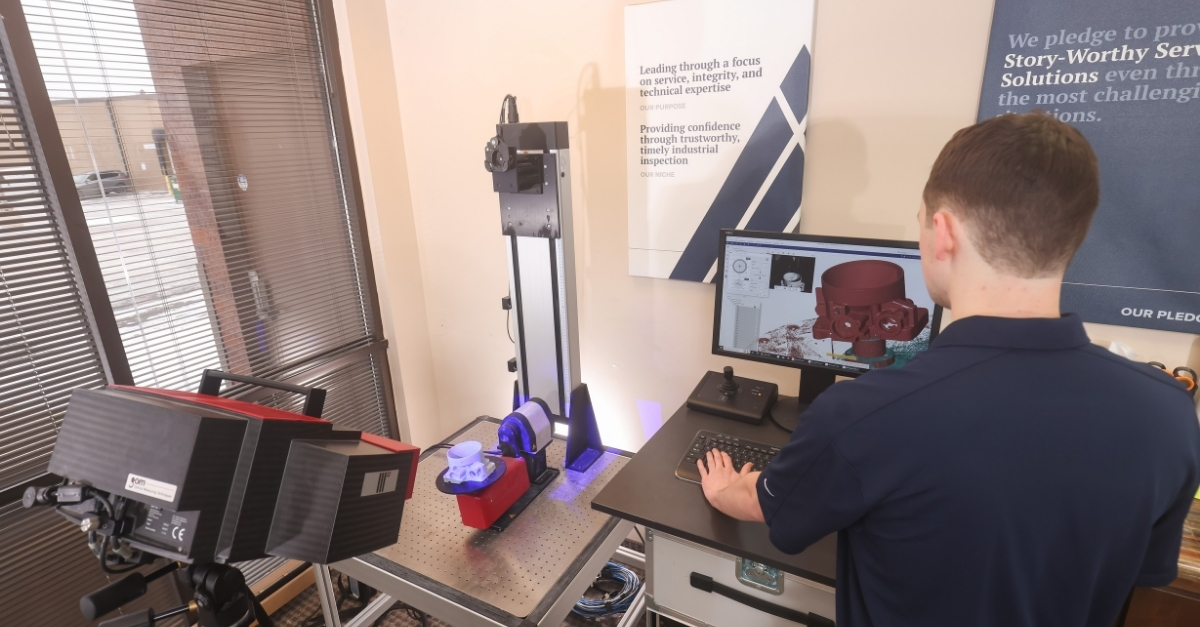
Outsourcing is the more cost-effective option when you need advanced equipment (or multiple types of tools) to scan different surface characteristics, sizes or shapes — or if you lack the equipment needed to meet the accuracy requirements of a specific customer. A leading metrology provider like Industrial Inspection & Analysis (IIA) invests in the latest tools and technologies, so you don’t have to.
Our Equipment
There are many ways to measure and inspect a manufactured product. That’s why IIA has amassed and developed an impressive array of state-of-the-art measuring instruments, equipment and technology over 40 years as a metrology leader.
From a few points of data to thousands of points, each type of equipment has strengths and weaknesses, depending on the application.
- Industrial CT Scanning is a highly accurate way of capturing large amounts of data, and is ideal for obtaining data about internal features and geometry. With some limitations in material type and size, this application isn’t for every product, but does a fantastic job when it’s the right fit.
- 3D Laser Scanning Equipment captures a very large amount of data very quickly. Products can range in size from a penny to an airplane or larger. There is a tradeoff between the amount of data and the accuracy of the data, but to obtain feedback on manufacturing processes, 3D laser scanning is one of the best options.
- Touch Probe Coordinate Measuring Machines (CMM) are the most widely used instrument to capture tactile data of a physical component. These can be used to extract singular points or many points when used in scanning mode. The data provides feedback on distances and features and allows for comparison between them. This type of equipment is extremely accurate and versatile.
- Vision CMMs utilize highly accurate cameras in conjunction with the accurate movement of the instrument to gather image data of distances and features. These also can gather singular points of data or many points. When materials are very soft, fragile, or easily scratched, a vision system may be the perfect tool to get the job done.
Going Above & Beyond
Beyond the standard dimensional inspection tools, IIA leverages state-of-the-art technologies to solve our customers’ most challenging inspections. Here are just two examples of IIA’s next-generation inspection technologies:
- Nikon 225XTH CT Scanner: One of our Minnesota lab’s most in-demand services is CT scanning with the state-of-the-art Nikon CT scanner. This versatile tool is ideal for inspecting items of various sizes and densities, both internally and externally. The Nikon CT scanner delivers sharp, highly detailed 3D images of internal structure, along with fast scanning speed for quick analysis of large samples. We can even use our Nikon CT scanner to perform non-destructive testing (NDT) to inspect components without damaging them.
- Bruker Alicona µCMM: The toolkit at our Irvine, California, lab includes the Bruker Alicona µCMM, a highly advanced and versatile tool for non-contact, optical 3D surface metrology. With unmatched accuracy and speed, it measures complex geometries, roughness, and form deviations on a variety of materials, allowing manufacturers to make informed decisions promptly. As our customers have discovered, the micro CMM is a game-changer when dealing with extremely tight tolerances and difficult-to-scan features.
Unique Solutions for Unique Problems
In the past, dimensional inspections of large, intricate parts could be problematic. Today, we can use the Hexagon Global Image 15 30 10 to measure parts up to 5ft (1.5 m) by 9ft (3m) with unparalleled precision, capturing millions of data points per second. If your part is too large or too delicate to ship, we can take our precision measurement services on the road, thanks to portable FARO CMMs equipped with laser scanners. Our mobile 3D scanning capabilities provide on-site, real-time analysis that can help manufacturers avoid or minimize a line shutdown.