
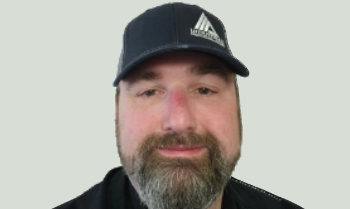
Things you may not know about Mike …
What does your workspace look like?
Lots of computer gadgets and 3D prints
What do you like to do outside of work?
3D printing and target shooting
What is your favorite type of music?
Everything from classical to heavy metal
What inspires you?
I am inspired by seeing young people who want to grow and learn something new and improve themselves and others. I am driven by a desire to learn new things in pursuit of being of maximum service to our customers and our company.
What’s your favorite movie?
Alien
If you could learn something new, what would it be?
Artistic CAD design
What’s your favorite food?
Steak
Do you have a favorite quote or piece of advice?
I have two: (1) There is never enough time to do it right, but there is always enough time to do it right. (2) Unless it explodes, it can only hurt your pride.
Mike Lyons - The Making of a Metrologist
In the mid-1990s, an enterprising California kid began working part-time as a data entry assistant for Q-Plus Labs, when it was still based in the owner’s garage in Rancho Santa Margarita. Little did Mike Lyons know that his side gig in high school would lead to a rewarding career as a respected metrology expert.
“I started out typing reports and it quickly evolved from there. Within the first year, I was doing CAD work, calibration of hand tools, and inspections in open set up,” says Mike. “The lab owner taught me to do high-precision measurement the right way — no cutting corners. I found work I was good at and stuck to it.”
Along the way, Mike became a Certified Quality Inspector and earned certifications in Print Reading and Tolerances, GD&T Fundamentals and GD&T Advanced Applications.
Today, Q-PLUS Labs, based in Irvine, California, is a leading dimensional metrology laboratories. The lab has been part of the Industrial Inspection & Analysis (IIA) family since 2023.
Over the years, the lab gained a competitive edge with its can-do attitude and cutting-edge equipment.
“Unless it was completely outside of our wheelhouse, we always found a way to get the job done. Saying ‘no’ was not an option for us,” says Mike, who watched dimensional inspection technology evolve by leaps and bounds.
“It was mostly open setup and CMM work for the first 7 years, then we got a structured light scanner and that opened a whole new realm for us,” he recalls. “When the lab added specialized form testing equipment, we were able to inspect small chamfers, fillets, threads, and other features that competing labs could not.”
On a few occasions, routine inspection work became deeply personal.
For example, at Q-PLUS, Mike worked for years with a medical manufacturer developing a heart monitor to track atrial fibrillation. Years later, his mother would need to wear one of those very monitors.
When Mike himself faced ablation surgery for an irregular heart rhythm, it was a perfect opportunity to connect the work done in the lab with a real person. It brought the importance of the work to a personal level for the metrology team.
“You really realize the weight of the work you do when working on medical components,” he says. “Someone’s health depends on this device, so you really need to get it right.”
Often, however, metrologists never know the end game for the part they’re inspecting. And for customers in highly sensitive and competitive industries, discretion is everything.
Once a race car engineering company brought a scale model into the lab under a tarp. “We had to sneak it into the garage because they didn’t want anybody seeing it,” says Mike, who also recalls 3D scanning of the rear doors of the USS Freedom and other memorable military projects.
“We did some work in the early years with a new fighter jet. It wasn’t the shape of the parts they were concerned about us knowing, it was the material,” he says. “They sent us plain carbon fiber components so we could write the programs. When they brought the actual components down, they were in a briefcase handcuffed to one of their employees. Those parts had to be in his sight the entire time.”
From the mysterious to the mundane, Mike enjoys the variety each day brings.
“It’s never the same thing from day to day,” says Mike. “You get to deal with all different kinds of parts and play with different types of scanners and software.” (And that’s just fine for this self-described computer nerd.)
After relocating to the Midwest to work as Application Engineer at IIA’s Minnesota Lab, the California native is finding variety everywhere he looks — from the weather to the culture to the cost of living. But one thing will never change for Mike: the importance of providing unbiased and accurate inspections.
“At some manufacturers, there are pressures to cut corners. As an independent, third-party lab, it’s not going to happen here,” says Mike. “Even when it’s news they don’t want to hear, I am completely honest and unbiased with customers about their parts. What they do with the information is up to them.”
More than 30 years since entering the world of metrology, Mike still gets a kick out of working on commercially available products and newsworthy projects — from smoke detectors to Mars rovers.
As he says: “One of the most satisfying parts of the job is working on something that you later see on store shelves or on the news and knowing that your fingerprints are all over it.”


