
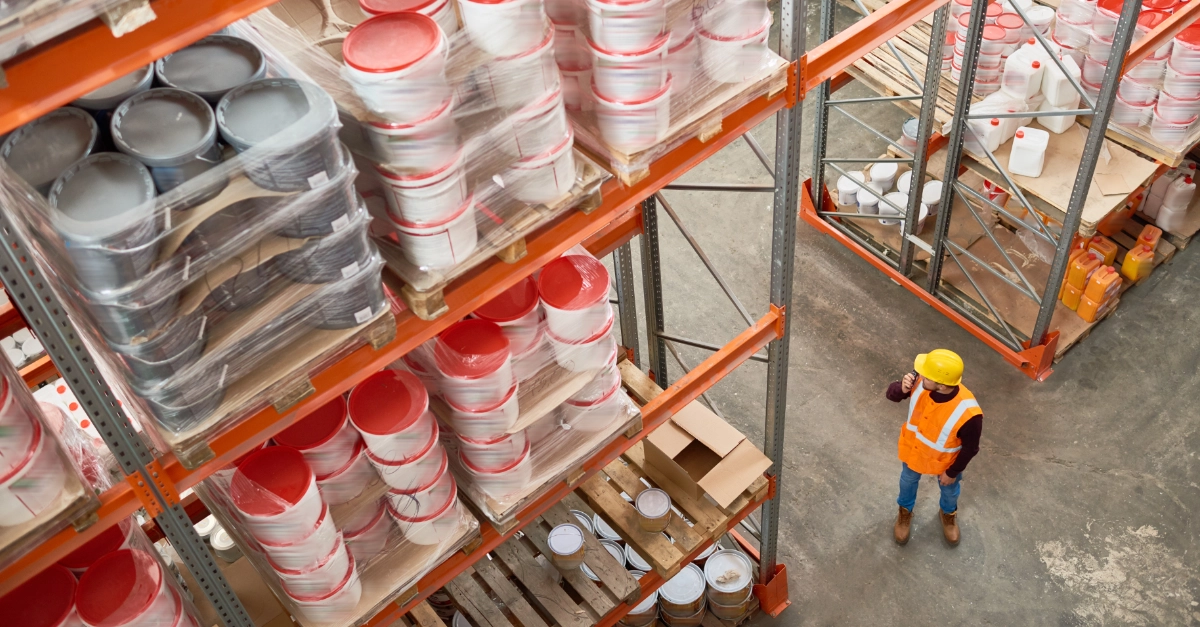
From massive warehouses to supply closets, heavy-duty steel storage racks are used in some form or fashion in virtually every industrial environment. While production-oriented equipment often takes center stage, routine inspection of storage racks is equally important.
Along with frequent in-house inspections, an annual, third-party structural inspection done under the supervision of a professional engineer (P.Eng.) will take safety and compliance to the next level.
When storage racks are not routinely maintained and inspected, they can become vulnerable to collapse, posing great risk to workers — not to mention product loss, downtime, legal liability and compliance risks. If even one storage rack is unstable, it can put the entire system at risk of a domino-style collapse.
The High Price of Failures
Fortunately, complete collapse of storage racking systems is not commonplace. But when they do occur, the results can be catastrophic.
From forklift mishaps to falling goods to cascading rack failures, storage racking failures are a significant cause of warehouse-related injuries and fatalities. According to the BHHC Safety Center, “Rack collapses rank among the top 10 causes of U.S. warehouse accidents, with an estimated annual economic cost of $36 billion from incidents linked to poor maintenance and inspection failures.” The Center also cites OSHA data that storage-related incidents, including racking failures, accounted for about 8% of all U.S. warehouse fatalities between 2020 and 2025.
Expert visual inspection, also known as visual testing (VT), combined with engineering oversight can help prevent a potentially catastrophic failure — and Industrial Inspection & Analysis (IIA) can help.
Why Racking Systems Fail
There are more than a few ways that industrial racking systems can weaken or fail. Common causes include:
- Improper Installation
- Corrosion or Unrepaired Structural Damage (e.g., corroded base plates, damaged columns, loose anchorage, bent diagonal bracing)
- Forklift Impact
- Inadequate Maintenance & Improper Repairs
- Failure to Re-inspect Repairs or Modifications
- Missing or Damaged Components
- Improper Pallet Placement
- Overloading
- Lack of Routine, Documented Inspections
Best Practices for Safety & Compliance
To minimize the risk of collapse, racking must first be installed correctly and accurately rated for load capacity. It then must be used and maintained properly on an ongoing basis. Warehouse personnel should be trained to recognize and report potential hazards and how to use material handling equipment safely.
Many collapses begin with an already weakened upright that is struck again, so it is critical to remove damaged equipment from service as soon as it is identified.
A comprehensive inspection program provides an additional layer of security. A common framework adopted by many companies includes:
- Daily/Continuous Operator Checks
- Weekly or Monthly Formal (Documented) In-House Inspections
- Annual Third-Party Structural Inspection Under the Oversight of a Professional Engineer
In addition to these routine inspections, storage racks should be re-inspected if they are struck by a forklift or if modifications are made.
Many companies already have a safety program in place that includes routine in-house inspections. In keeping with industry standards and recommendations, an annual structural inspection done by independent experts and overseen by a Professional Engineer will support your company’s due diligence efforts and provides an added level of assurance regarding the safety and integrity of your rack systems.
Relevant Standards & Regulations
In North America, the following standards provide guidance and best practices to ensure the safety and structural integrity of industrial storage racking systems:
- Canada: The CSA A344 standard, User Guide for Steel Storage Racks, recommends that an expert structural inspection be done annually under the supervision of a professional engineer. In addition, provincial Occupational Health & Safety (OHS) guidance may apply to the use of storage racks in Canada. For example, Ontario Regulation 851 – Industrial Establishments — requires a Pre-Start Health and Safety Review (PSR) under the supervision of a professional engineer for any newly installed racking system.
- United States: Two main standards — ANSI MH16.1-2024, Design, Testing, and Utilization of Industrial Steel Storage Racks, and ANSI MH16.3-2016, Specification for the Design, Testing and Utilization of Industrial Steel Cantilevered Storage Racks — both recommend annual inspection by a qualified expert.
While the U.S. Occupational Safety & Health Administration (OSHA) does not provide a detailed, rack-specific inspection standard, the expectation is that industrial storage racking systems be maintained in a safe condition and inspected appropriately. OSHA frequently treats compliance with ANSI standards as evidence of recognized safe practice when evaluating warehouse rack safety.
OSHA also commonly cites the following to support citations involved damaged or unsafe pallet racking:
- 29 CFR 1910.176(b) — “Storage of material shall not create a hazard” and materials must be “stacked, blocked, interlocked and limited in height so that they are stable and secure against sliding or collapse.”
- The General Duty Clause (Section 5(a)(1) of the OSH Act)
- Forklift standards in 1910.178
- Manufacturer instructions & recognized industry standards
Compliance with CSA or ANSI standards will help protect people and property, and show due diligence should an incident occur.
How IIA Can Help
Industrial Inspection & Analysis is one of North America’s leading providers of non-destructive examinations, including visual testing (VT). We have performed engineer-led structural inspections of steel storage racks at nuclear plants, petrochemical facilities, construction companies, and many other industrial environments to meet the highest standards.
Because visual testing is a subjective process — informed by an inspector’s skill and experience — it’s important to partner with an inspection leader like IIA. Our skilled and experienced Levels 1-3 visual inspectors are certified to CSA W178.2 in Canada and to ASNT SNT-TC-1A and CP-189 standards in the U.S.
Along with visual testing, we offer a wide array of inspection services and unrivaled customer support. Our team includes professional engineers who work closely with our inspectors to ensure the safety and reliability of your equipment.
Routine structural inspection by independent experts is essential to the safety of any equipment your operation depends on, including storage racks. Don’t put safety on the shelf — call IIA.


