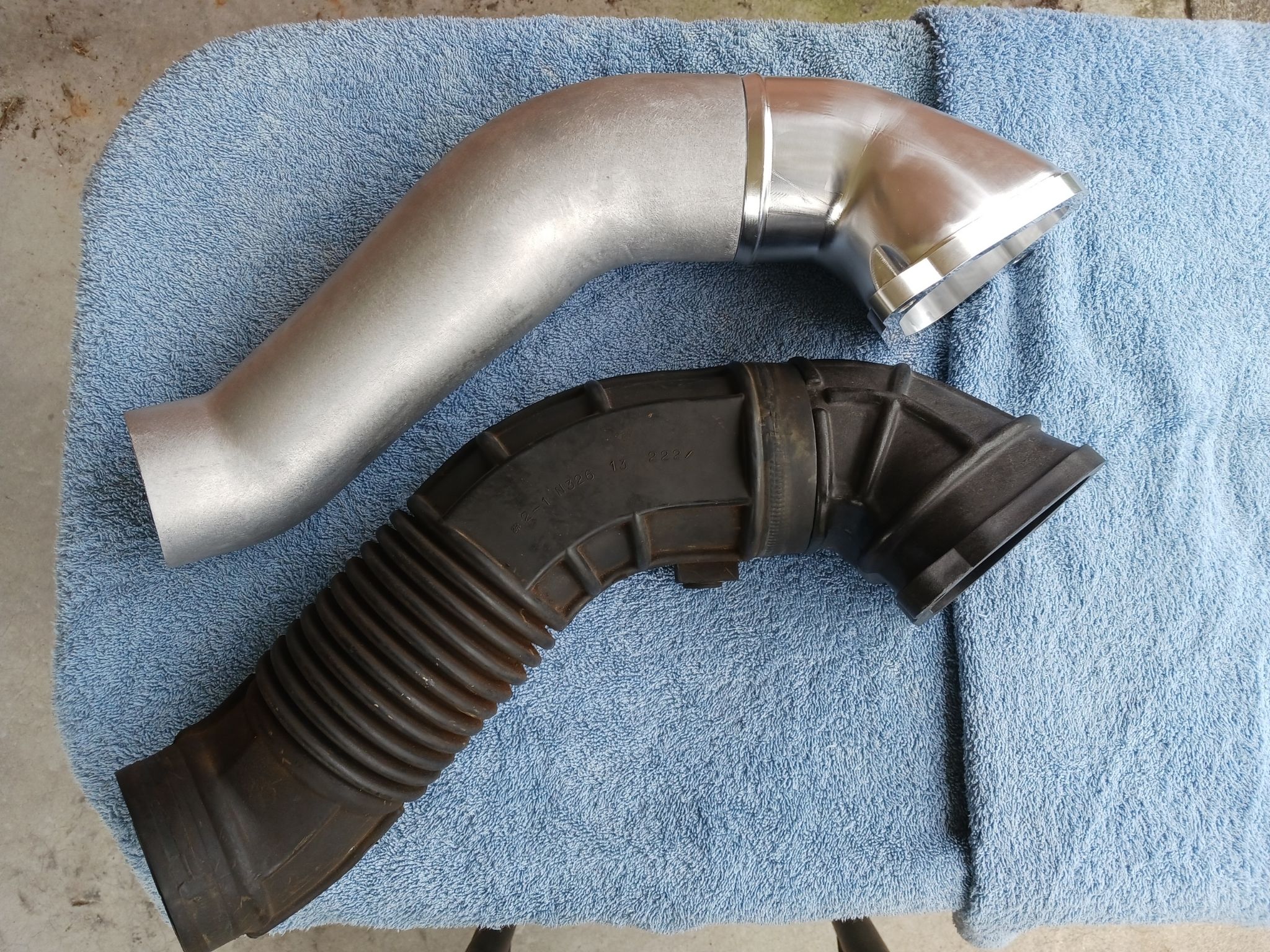
Back in 2023, when car aficionado Craig Rogers needed to reproduce a part for his prized 1986 Mazda RX-7 FC project car, he sought the help of Industrial Inspection & Analysis (IIA). With four decades of metrology experience, our Minnesota lab was happy to tackle the task.
Dimensional inspection, such as 3D laser scanning, is the first step in the reverse engineering process, which allows for legacy parts to be accurately reproduced when no design files exist.
The part in question — a cold air intake hose — was a flexible part that could be bent and clamped into place. However, to enhance the car’s performance, Craig planned to have the new tube made from aluminum.
A precision 3D scan from IIA was the first step in the process. However, when IIA Application Engineer Paul Salzer realized the job called more for redesign than replication, he provided engineering expertise to ensure the customer received a part that fit his car.
“There was a slight issue with doing a straightforward scan and replicating the part as is,” explains Paul. “The original rubber part could be bent and clamped down to fit in place. But when you make that part out of metal, it won’t fit because you no longer have the ability to bend the part and clamp it down.”
Paul began redesigning the part to ensure a good fit. First, he used a structured light scanner to gather detailed dimensional data on the hose.
“I scanned both the hose and the intake elbow and basically redesigned it within that same envelope. I could see where the clamp was, so I knew where to stop it short so it would fit in position,” says Paul.
“By redesigning it, we were able to remove the internal ribbing from the rubber hose and make a smooth transition. This would create less restriction in the tube and a smoother air flow, which in turn creates a slight performance increase from the factory part.”
Using SolidWorks software, Paul then created a 3D CAD model of the redesigned part. The customer was able to share that model with an additive manufacturer to have an aluminum intake tube 3D printed. The new part fit perfectly in his 40-year-old car.
As Paul says, “3D scanning allows us to gather dimensional data or form and fit data from a 3D scan and use that data not just to replicate, but to redesign a part and make it a little bit better.”