
Around pools, we tend to see slides as all fun and games. But a “WEEEEE” can quickly turn into a “WHOA!” if a slide does not meet strict safety specifications.
To reduce unreasonable risk of death or injury, the U.S. Consumer Product Safety Commission (CPSC) sets safety standards for the manufacture and construction of swimming pool slides. As a trusted provider of CPSC Testing, Industrial Inspection & Analysis (IIA) has carved out a bit of a niche specialty in testing slides destined for water parks or indoor swimming facilities.
Tapping Our Talent Pool
One critical hands-on CPSC test must be performed by someone of “average adult” size — specifically, 162±5lbs and 71” ±2” tall.
“Guess who fits that build?” asks Nick Batts, Assistant Mechanical Manager at IIA’s St. Louis lab, who knows the answer all too well. His stature met CPSC parameters and landed him the unlikely role as IIA’s “slide expert” more than a decade ago.
Since then, Nick has tested a few dozen different slides made by various manufacturers.
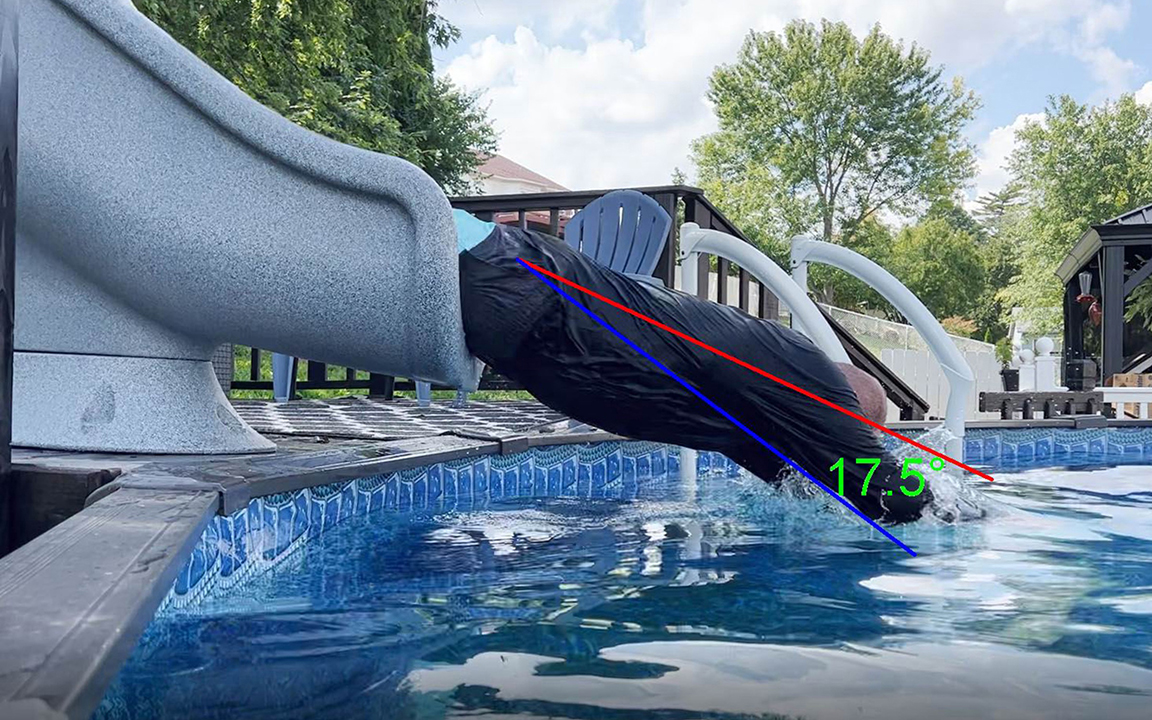
“I still find it very strange that I’ve become some type of expert at going down these slides, but it’s for safety,” says Nick. “The angle of attack is one of the measurements that manufacturers are most concerned with. They want to make sure that when you come off the end of the slide, you don’t skip across the water or plunge straight to the bottom. And if the slide has turns or curves, they want to be sure you’re not going to come up that curve and potentially come off the slide.”
Before Nick takes the plunge, he sends a test assembly down the slide first. Equipped with a marker, the test assembly charts the path it takes down the slide. Ideally, that path will be within 41% of runway width to the runway center, and Nick’s journey will follow roughly the same path. If the test assembly goes too far up the side in the middle of a turn — or worse yet, comes off the slide altogether — the slide fails the test, and Nick is spared a risky test run.
To document test runs, Nick sets up two cameras outside of the slide. One captures a broader view, while the other zooms in on the slide’s exit into the pool. To ensure good video footage is captured for the client, Nick typically makes several runs down the slide (purely for the sake of science, of course.)
In addition to the test run, Nick also performs dimensional and performance tests required by CPSC specifications for pool slides, including:
- Checking for sharp edges that could injure a rider
- Verifying that ladder angle meets specified degree
- Checking tread design and dimensions
- Assessing slip resistance of tread on ladder steps and platform
- Measuring hand rail length, height and diameter
- Load testing the slide to 350 pounds
Sliding the Extra Mile
Beyond going down a slide, Nick goes the extra mile for clients by occasionally traveling to perform on-site slide testing. In fact, his most memorable sliding experience took place on a 20-foot-tall, completely enclosed slide in a brand-new sports complex in Atlanta, Georgia.
“It was so strange going down this slide all by myself inside this huge, completely quiet, sports complex. It’s the only slide I’ve ever gone down that was completely sealed, so I couldn’t see where I was going,” recalls Nick. “The scary part was going down headfirst in the prone position — I was not eager to do that. And it kept turning and turning before I came out the bottom. It was scary at first, but fun in the end!”
On another memorable occasion, a pool slide manufacturer came to IIA in December with an urgent request for slide testing to help them meet a planned spring 2026 rollout.
“This particular client was in a real hurry because they were trying to debut the slide for summer. Unfortunately, it was 20 degrees outside in St. Louis when the prototype arrived,” recalls Nick. “We built a pool inside our shipping warehouse and warmed up the pool so I could go down the slide.”
Sliding for Safety
Along with the success stories come the times when things don’t go as the manufacturer planned. Nick recalls the first slide he had to fail.
“As I was going up the ladder to take measurements, I noticed the stairs were awfully soft. When I began load testing, the stair started buckling at around 185 pounds. I had to let the manufacturer know the slide did not pass the required 300-pound load test,” recalls Nick. “It’s better to learn these things during testing than after, so the slide can be made safe. That’s why we test.”
As a hands-on manager who welcomes unusual testing assignments, Nick embraces his “slide-gig” as just another day at the office.
“I never thought I’d be going down pool slides at work, but I enjoy it and look forward to it,” says Nick.
As a keen safety advocate — at work and at home — Nick is well aware of the serious side to this fun gig.
“Most people never realize how much design work and testing goes into a slide, but at some point, thousands of people are going to go down this thing,” he says. “The testing we do helps protect kids and adults to ensure that a day at the pool is nothing but fun.”


