
Qualify Your Additive Manufacturing With CT Scanning
To the delight of engineers everywhere, the emergence of additive manufacturing, or 3D printing, offers the freedom to go where traditional manufacturing simply cannot. Much of the buzz around additive manufacturing is due to a dramatic decrease in production times — even as the demand for customized products accelerates.
Challenges & Considerations
Although 3D printing has transformed modern manufacturing, qualifying an additively manufactured part still comes with its own set of hurdles.
Manufacturers must navigate strict regulatory requirements, increasing pressure to adopt reliable measurement solutions, and the ever-present constraints of time and budget. Highly regulated industries—such as medical devices, aerospace, defense, and automotive—face even greater scrutiny, as part validation is directly tied to safety and compliance.
At the same time, customers expect inspection results faster than ever. Traditional measurement methods often force engineers into a slow, costly process of elimination: Is the issue with part A or part B? Is the design flawed? Are tolerances too loose? Is the machine producing the part accurately? Weeks or even months can be lost chasing down the root cause, with significant financial impact.
So where does that leave additive manufacturers?
Radiography (X-ray) is one option, though it can be expensive. Cutting parts open is another, but it’s destructive and wasteful.
Fortunately, there’s a solution that avoids both drawbacks: a cost-effective, non-destructive, and minimally intrusive method ideal for additive components: CT scanning.
Benefits of CT Scanning
CT scanning gives manufacturers the ability to qualify parts non-destructively in ways no other inspection method can match. It is especially valuable for precision components with intricate, fine, or internal geometries that are difficult—or sometimes impossible—to measure using laser scanning or CMM technologies.
By capturing the internal structure of an additively manufactured part in full 3D, CT scanning provides fast, highly accurate validation without applying external forces that could distort or damage the component. Depending on part size, material, and scan setup, industrial CT can achieve micron-scale voxel resolution.
Case Study Using Sample 3D Printed Part
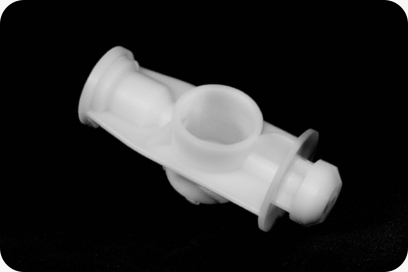
Here, we have a sample part that the Lab Services team at Industrial Inspection & Analysis (IIA) had made at a local 3D printing company. As you can see, the complexity of this part doesn’t allow for traditional inspection methods. How can we qualify the internal features without destroying the part? The reported accuracy of this particular 3D printing machine is +/-.005. Sounds pretty great. But who’s validating the machine? Who’s proving this .005?
While well-established standards exist for CNC machine verification, additive manufacturing equipment often lacks similarly mature, universally adopted performance qualification standards. We’re left to trust what the manufacturers and printers tell us about the accuracy of their machine.
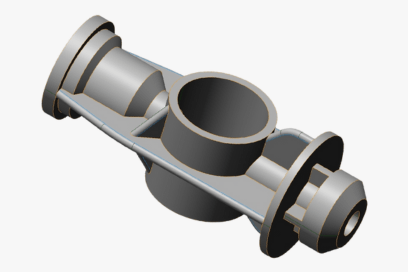
Using the sanitized digital representation of the part, a parametric or organic model can be built with extreme accuracy. Below is the design of the part.
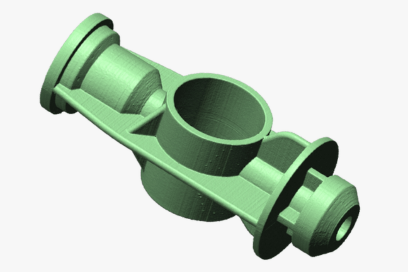
Compared to hand tools that capture point-to-point measurements, 3D scans more accurately capture the original part’s geometry, saving an incredible amount of time. The CT system used is capable of sub-micron voxel resolution under optimal scan conditions; however, dimensional accuracy is verified per application using calibrated artifacts.
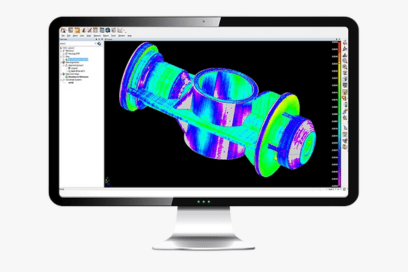
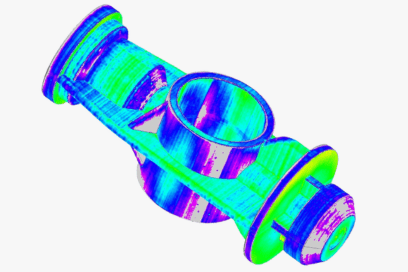
To qualify your part, we’re going to overlay the data on the CAD. We do this by either a datum alignment or best fit. Alignment strategy (datum-based vs best-fit) must be selected based on engineering requirements and GD&T intent, as best-fit alignment can mask functional non-conformances. Once these are overlaid, we do a measurement from data to CAD to display deviations.
What you’re seeing in color is deviation from nominal. Anything that isn’t green doesn’t match the CAD. Areas in cool colors such as blue and pink are negative or less material. Areas that are yellow or red — warm colors — are positive material.
Cost always depends on the size and complexity of the part, along with what chamber it fits in. But in comparison to the multiple hours, weeks and months of trying to find the problem the old way, the cost is minimal. Time is money.
CT Scanning: An Ideal Option for Additive Manufacturers
In summary, the reason that your 3D printed part is not a candidate for traditional manufacturing methods is the same reason it is not an ideal candidate for traditional inspection methods — but it is just as vulnerable to failure.
It’s a common misconception that additively manufactured parts don’t require inspection because they will be produced perfectly and within the machine’s stated accuracy. In reality, manufacturers’ accuracy claims are not a substitute for independent verification, and standardized methods for validating additive manufacturing equipment accuracy are still evolving. As a result, relying solely on machine specifications can introduce unseen risk.
A highly experienced inspection vendor like IIA can use industrial CT scanning to qualify additive manufactured parts quickly, while reducing inspection and production costs. In addition, you won’t have to deal with the process of elimination when your prototype doesn’t function. That means you save time and money and get to market faster.
IIA Can Help
With decades of experience, IIA provides high-quality dimensional inspection, advanced 3D scanning, modeling analysis, and geometry re-creation services that save time and money for manufacturers. Our highly trained professionals can promptly scan your additive manufactured parts in any phase of the product life cycle — during or after the development of your product.
We will customize your project to accurately and precisely meet your needs. We pride ourselves on our quality service, and we are confident that your manufacturing process will greatly benefit from more rapid and cost-effective results.


