A Toronto treasure for nearly 100 years, the Glen Road bridge (officially known as the Morley Callaghan Footbridge) connects the communities of Rosedale and St. James Town and offers pedestrians a satisfying view of the natural splendor found in Rosedale Valley Ravine.
Built in 1927, the bridge stretches roughly 197 meters (645 feet) across and sits about 20 meters (65.5 feet) above Rosedale Valley Road. The structure consists of seven spans, with the middle span designed as a steel deck arch.
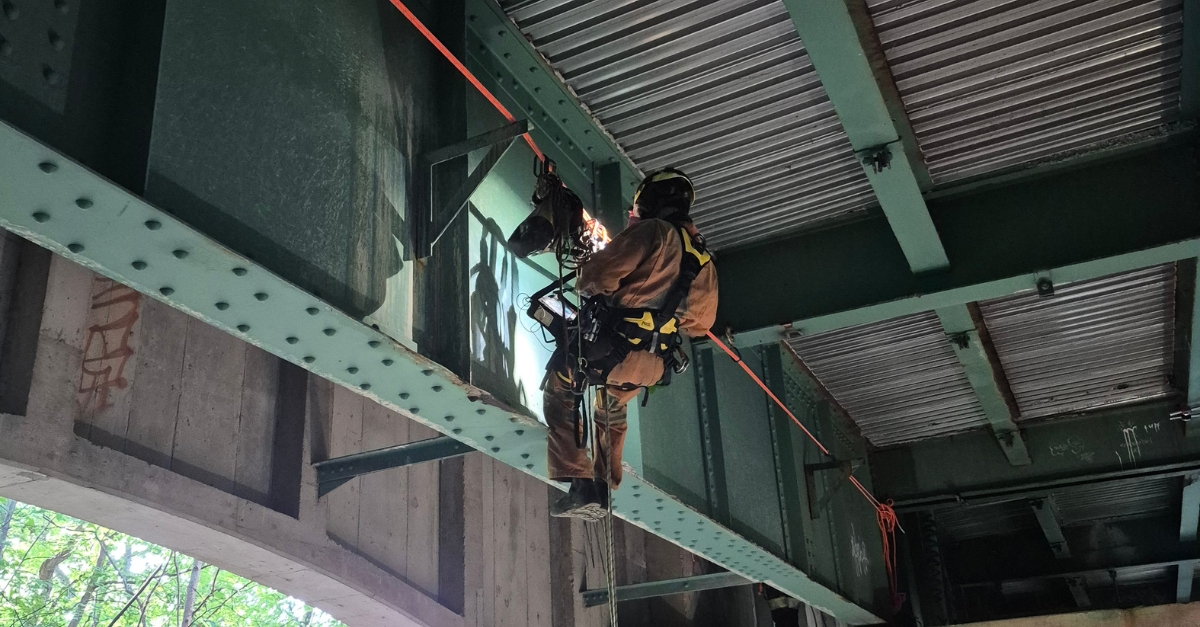
In early 2026, Industrial Inspection & Analysis (IIA) provided non-destructive inspection of the recently refurbished bridge. The scope of work included visual inspection, magnetic particle inspection, and ultrasonic thickness testing to evaluate the condition of steel members, rivets, nuts, and bolts, measure corrosion and possible section loss, and identify any fatigue cracks.
Our team was tasked with completing work in a safe and timely manner, while minimizing disruptions to vehicle and foot traffic on this busy bridge.
“Since vehicles and pedestrians use the bridge, and there is also a park and trail underneath, closing the bridge was not possible,” says IIA Project Coordinator Amirali Cheraghi. “For this reason, it was decided that the inspections had to be carried out using rope access.”
Rope access is an efficient and affordable method of accessing difficult-to-reach inspection environments, from bridges and towers to wind turbines and wells. By using a system of ropes to climb, descend or move laterally across a structure or site, rope access inspections minimize disruption and downtime to site operations.
Since the bridge remained open to vehicular and pedestrian traffic while testing was underway, the project required extra attention and careful coordination to maintain both worker and public safety. In addition, Mother Nature made a difficult job even more challenging for our intrepid inspectors, who worked at heights up to roughly 46 meters (150 feet) above the pedestrian trail.
“Our team faced different weather conditions, including windy days, rain, and snow. These conditions made the work more sensitive while technicians were on ropes,” says Amirali. “In addition to the daily job hazard analysis, our team continuously assessed the situation to identify any potential safety concerns and address them accordingly.”
Despite the challenges, IIA safely and successfully completed the inspection one week ahead of the original schedule, and a comprehensive report was submitted to the client addressing all of their requirements.
In spite of the inherent risks of working at heights, rope access inspections are extremely safe and fast compared to other alternatives. IIA is proud to provide services that will help ensure the safety and longevity of this Toronto landmark for years to come.